
Key takeaways
- U.S. home prices remain elevated due to tight supply, and this is in turn weighing on sales.
- J.P. Morgan Global Research expects home prices to remain flat in 2026 and increase by 3% in 2027.
- The new 21st Century ROAD to Housing Act introduces more than 40 supply-side provisions, but its impact on affordability will depend on implementation.
The U.S. housing market faces a deepening affordability crisis that is driving home ownership further out of reach for many consumers. Median home prices have risen for 36 straight months, soaring to an all-time high of $440,600 in July — up 1.8% from a year ago, according to the National Association of Realtors (NAR).
To this end, Congress recently passed the 21st Century ROAD to Housing Act in July — a bipartisan piece of legislation that aims to reduce housing costs and increase housing supply. Could the new bill help lower home prices? And what’s the broader outlook for the U.S. housing market?
“Housing affordability remains strained. The cost-to-income ratio for buying a home sits at 35%, and buying is cheaper than renting in only around 2% of metropolitan statistical areas.”

John Sim
Head of Securitized Products Research, J.P. Morgan
Why are US house prices so high?
House prices are stubbornly high due to a chronic shortage of affordable homes, which is the result of more than a decade of underbuilding following the 2008 financial crisis. Builders have been hindered by zoning laws, land use restrictions and high labor costs, which have exacerbated the shortfall. While construction has increased in recent months — with some areas in the West Coast and Sun Belt even experiencing a glut of new homes — inventory is still tight overall.
“Housing affordability remains strained. The cost-to-income ratio for buying a home sits at 35% [surpassing historical benchmarks], and buying is cheaper than renting in only around 2% of metropolitan statistical areas,” remarked John Sim, head of Securitized Products Research at J.P. Morgan.
The so-called ‘lock-in effect’ is compounding the supply shortage. Homeowners locked into low pandemic-era mortgage rates are reluctant to sell, as they cannot transfer those favorable rates to a new property. With current mortgage rates hovering around 6.6%, the financial cost of moving has become prohibitive for many. Against this backdrop, existing-home listings have yet to recover back to pre-pandemic levels. “The lock-in effect has faded somewhat but continues to keep many potential sellers on the sidelines, constricting inventory and putting upward pressure on prices,” said Bennett Parrish, a U.S. economist at J.P. Morgan.
Overall, growth in housing supply is expected to remain sluggish, which should keep affordability conditions under pressure. Existing-home listings were up just 1.3% in June versus one year ago, down from 1.9% in May. “While soft demand is keeping a lid on the pace of appreciation, thin supply is keeping price growth positive,” Parrish added. As such, J.P. Morgan Global Research sees home prices (as per the S&P Cotality Case-Shiller U.S. National Home Price Index) remaining flat in 2026 and increasing 3% in 2027.

U.S. home prices are forecast to rise by 3% in 2027.
Why are US home sales falling?
Persistent affordability concerns are weighing on demand. According to NAR, existing home sales pulled back 2.4% in June to a seasonally adjusted annual rate of 4.09 million units. All in all, sales have fallen 4.2% over the first half of 2026.
NAR attributed the softness to higher mortgage rates, reiterating that buyers remain highly sensitive to fluctuations in borrowing costs. While J.P. Morgan Global Research expects the Fed to be on hold for the rest of the year, mortgage rates could remain elevated, especially as renewed tensions in the Middle East could rekindle inflation concerns.
“Although the pipeline of potential homebuyers remains large, affordability challenges and rate volatility could stall origination growth, particularly if elevated rates persist,” said Richard Shane, head of Consumer and Specialty Finance Research at J.P. Morgan. “Industry forecasts have moved lower accordingly.”
US home sales remain soft
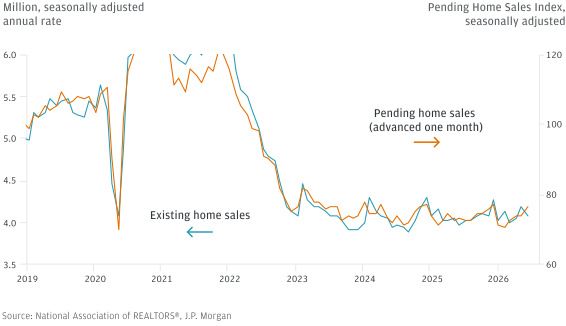
Existing and pending home sales fell sharply in 2022 largely due to record high mortgage rates and have remained soft ever since.
What is the 21st Century ROAD to Housing Act?
The 21st Century ROAD to Housing Act was signed into law on July 11 with broad bipartisan support, marking the most significant federal housing legislation in decades. It includes more than 40 provisions aimed at boosting the availability of affordable housing, including:
- Prohibiting large institutional investors from buying single-family homes; however, there are certain exceptions, including built-to-rent properties.
- Empowering state, local and tribal governments to streamline environmental reviews for housing projects.
- Expanding the legal definition of manufactured homes by removing the requirement for a permanent chassis. The chassis provides structural support during transport but is often unnecessary once the home is installed.
- Incentivizing municipalities to increase housing supply through measures such as financial grants and zoning reform guidance.
In particular, the new regulations for manufactured housing could have a major impact on affordability, as noted by Anthony Paolone, co-head of U.S. Real Estate Stock Research at J.P. Morgan. “Manufactured housing in the U.S. has been subject to a variety of regulations and local zoning, significantly limiting the amount of it. One element of the historical state of play is that manufactured homes are required to have a permanent steel chassis. This is a source of a lot of community opposition, as well as the stigma attached to these types of homes,” he said. “Taking this requirement away could potentially reduce the cost of this type of housing further and, importantly, make these communities [more appealing].”
Overall, while the 21st Century ROAD to Housing Act signals a shift toward pragmatic, supply‑side solutions, its impact remains to be seen — especially as it will only be officially enacted on January 7, 2027. Ultimately, success will depend on the effective implementation of its regulatory reforms. For now, J.P. Morgan’s base case remains: home prices flat in 2026 before rising in 2027, with affordability remaining a key concern for the foreseeable future.
Related insights
-

Global Research
Mid-year market outlook 2026: The tug of war continues
July 01, 2026
While the global expansion stands on solid ground, markets will need to balance competing forces as they head into the second half of the year.
-

Global Research
What’s the Fed’s next move?
September 25, 2026
The Fed raised rates in September, marking the first hike in three years. Is this the start of a longer hiking cycle?
-

Global Research
AI and geopolitics reshape the 2026 labor market
April 21, 2026
The U.S. labor market in early 2026 stands at a crossroads. How will shocks from military conflicts and rapid AI adoption influence the market in the second half of the year?
This material (Material) is provided for your information only and does not constitute: (i) an offer to sell, a solicitation of an offer to buy, or a recommendation for any investment product or strategy, or (ii) any investment, legal or tax advice. The information contained herein is as of the date and time referenced in the Material and J.P. Morgan does not undertake any obligation to update such information. J.P. Morgan disclaims any responsibility or liability, whether in contract, tort (including, without limitation, negligence), equity or otherwise, for the quality, accuracy or completeness of the information contained in this Material, and for any reliance on, or uses to which, this Material, is put, and you are solely responsible for any use to which you put such information. Without limiting any of the foregoing, to the fullest extent permitted by applicable law, in no event shall J.P. Morgan have any liability for any special, punitive, indirect, or consequential damages (including lost profits or lost opportunity), in connection with the information contained in this Material, even if notified of the possibility of such damages. Any comments or statements made herein do not necessarily reflect those of J.P. Morgan, its subsidiaries or its affiliates.
All materials and information shared with you are, unless otherwise indicated to you, proprietary and confidential to J.P. Morgan. You are hereby notified that any disclosure, dissemination, copying, distribution, or use of the information provided to you, in whole or in part, other than as expressly permitted by J.P. Morgan, is STRICTLY PROHIBITED. You are permitted to disclose the materials and information to your officers and employees on a need to know basis. Should you have any questions regarding this, please contact your usual J.P. Morgan contact. For further information please visit:https://www.jpmorgan.com/pages/disclosures/materialdisclaimer.
© 2025 JPMorgan Chase & Co. All rights reserved. J.P. Morgan is a marketing name for businesses of JPMorgan Chase & Co. and its subsidiaries and affiliates worldwide. JPMorgan Chase Bank N.A. (member of FDIC), J.P. Morgan Securities LLC (member of FINRA, NYSE and SIPC), J.P. Morgan Securities plc (member of the London Stock Exchange and authorized by the Prudential Regulation Authority (PRA) and regulated by the Financial Conduct Authority and the PRA) and J.P. Morgan SE (authorised by the BaFin and regulated by the BaFin, the German Central Bank and the European Central Bank) are principal subsidiaries of JPMorgan Chase & Co. For legal entity and regulatory disclosures, visit: www.jpmorgan.com/disclosures. For additional regulatory disclosures, please consult: www.jpmorgan.com/disclosures.